The humanitarian sector has extensive libraries of frameworks, guidance notes, emergency response protocols and anticipatory action strategies. What is missing is software that turns those principles into something a field team can use.
CLEAR builds that infrastructure.
The data exists.
The frameworks exist.
The gap is everything in
between.
Conflict monitors, weather forecasts, displacement monitors — field teams have them all, in separate tabs, in different formats, none of them talk to each other. By the time someone pieces it together, the window for early action has closed and conditions have deteriorated. This gap today is still measured in weeks.
Preparedness frameworks, anticipatory action protocols, early warning strategies, the sector has a rich vocabulary for what needs to happen. It lacks the software to operationalize it. Good principles stall when there's no system to execute them.
Most humanitarian data systems are designed for retrospective analysis: what happened, who was affected, what was done. CLEAR is built for the moment before, providing actionable insights when there is still time to change the outcome.
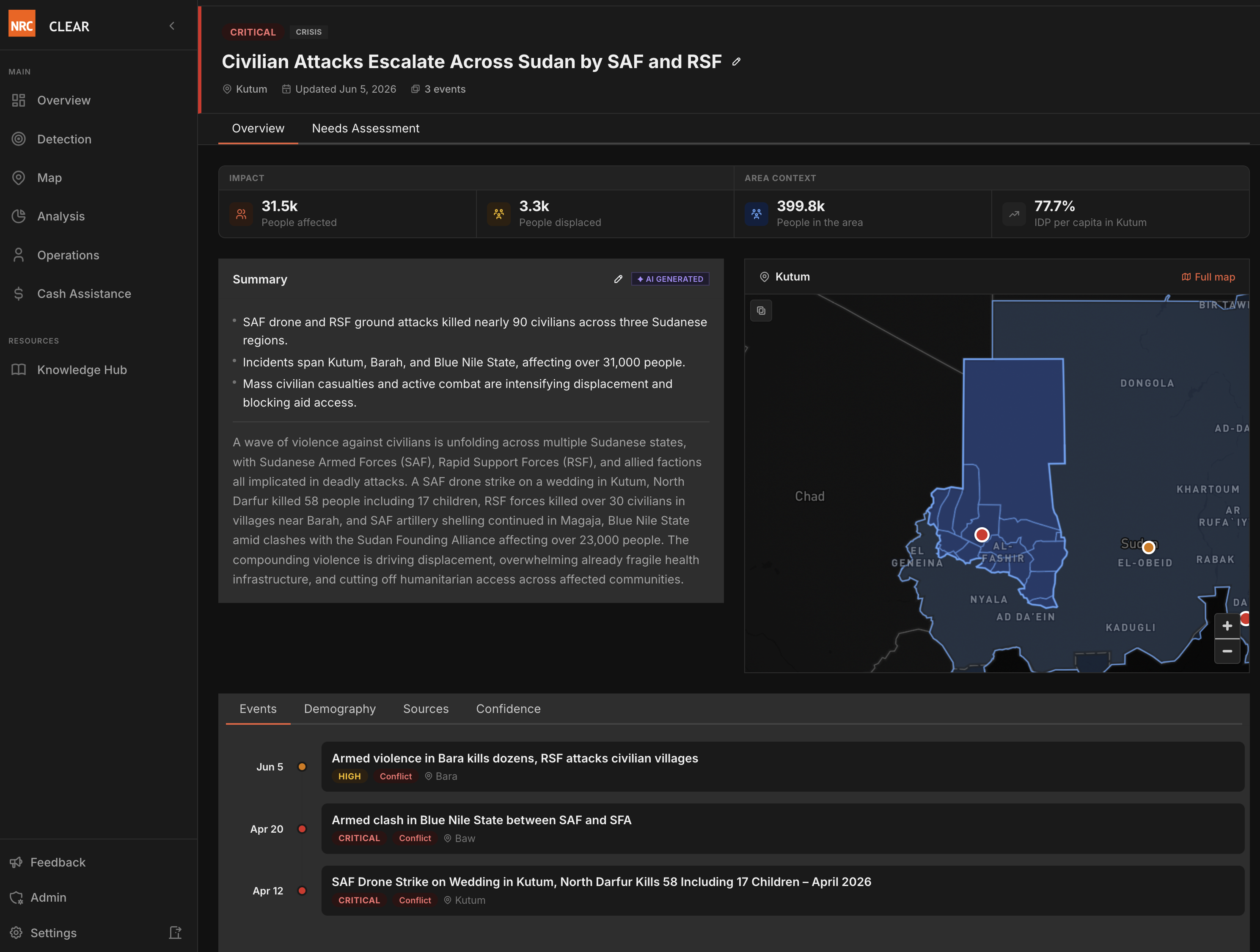
Sudan is CLEAR's first operational context, one of the largest and fastest-growing displacement crises in the world, with over 14 million people forced from their homes.
The live interface aggregates conflict monitoring, displacement tracking, and field data at sub-national level — delivering near real-time actionable insights to NRC emergency teams.
"The challenge isn't data scarcity, it's delivering insights at the right time, to the right people, in a format they can trust and act upon."CLEAR Initiative, Humanitarian Landscape Report 2025
| Capability | Typical Early Warning Systems | Humanitarian Data Platforms | CLEAR |
|---|---|---|---|
| Crisis detection | Single-hazard signals | Aggregated reports | ✓ Multi-source, real-time anomaly detection across climate, conflict, displacement |
| Level of analysis | National / global | Cluster-level summaries | ✓ Sub-national, operational — built for the team on the ground |
| Output format | Bulletins, dashboards | Situation reports | ✓ Live updates with actionable insights and course-of-action recommendations |
| Timing | Periodic updates | After-event coordination | ✓ Anticipatory or near real-time, designed to intervene before peak crisis impact |
| Decision support | — | Coordination summaries | ✓ GenAI Emergency Response Console with action plan recommendations grounded in impact forecasting and past response patterns |
| Use of AI | Rule-based alerts | Basic automation | ✓ Responsible AI throughout — explainable, small and specific models, human-in-the-loop at all critical decision points, bias mitigation |
| Data integration | Single-source feeds | Manual data aggregation | ✓ API-first, 4-layer architecture — ingestion, processing, governed storage, and access — across satellite, social, field, and climate sources |
| Data infrastructure | Siloed, org-specific | Shared reports only | ✓ Federated data marketplace with shared feature repository and model registry — reducing duplication across the sector |
| Data sovereignty | Vendor-controlled | Platform-dependent | ✓ Federated governance, cloud-agnostic architecture, data sovereignty considerations at each step |
| Open source | — | — | ✓ Open-source codebase with community contribution model — built to be owned by the sector, not a vendor |
| Sustainable build | Grant-dependent tools | Institution-funded | ✓ Consortium model with shared costs, open infrastructure, and a roadmap toward sector-wide adoption over 3 years |
| Collaboration | Data sharing agreements | Cluster coordination | ✓ Built with and for the community — open, multi-org data ecosystem, umbrella API connecting existing platforms, building the sector's missing integration layer |
| Rapid response link | — | Referral only | ✓ Integrated end-to-end insights with automated vulnerability mapping and response decision support |
| Community voices | One-way alerts | Feedback surveys only | ✓ Lightweight, contextual feedback integrated into alerting, analysis, needs assessment, and monitoring. |
CLEAR integrates affected communities into alerting, situation analysis, needs assessment, and monitoring through lightweight, contextual feedback mechanisms embedded into field operations. This means real community voices inform what's analyzed, how it's prioritized, and what actions matter most.
AI-powered real-time monitoring across satellite imagery, social media, climate feeds, and field reports. Anomalies trigger automatically, analysts verify and enrich the signal.
Once an alert fires, the field interface pulls together what matters: who's affected, where they are, which routes are open, how markets are holding. Complex data made readable on one screen.
Draws on standards, SOPs, past responses to similar crises and current field data to give coordinators a clear picture and suggested next steps.
Detection triggers assessment. Assessment informs targeting. Targeting enables cash to move. The goal is to close the gap between a signal and money in someone's hand.
CLEAR is an open ecosystem designed to serve the whole sector. If your organization works in early action, crisis response, or humanitarian data, we want to hear from you.